
Interactive 360 Product Views: The Future of eCommerce Immersive Experiences
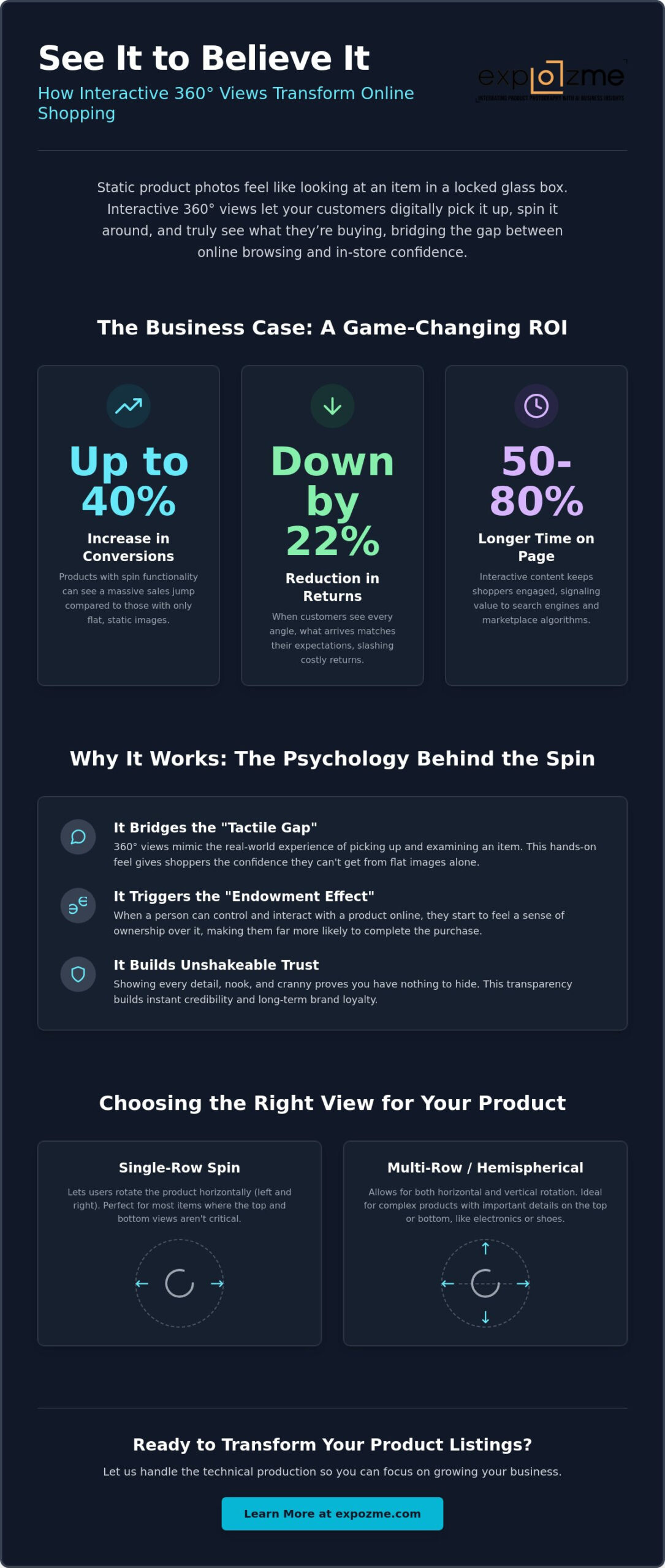
Did you know that products featuring a spin function can see a conversion rate increase of up to 40 percent compared to those using only static images? Research shows that retailers who implement these viewers also report a reduction in return rates by as much as 22 percent. It’s a massive shift that proves just how much shoppers value being able to see every angle of a purchase before they hit the checkout button. You’ve likely felt the frustration of high return rates because a customer didn’t fully understand a product’s scale or detail from a few flat photos. When your listings feel outdated compared to the competition, it’s hard to build the trust needed to close a sale.
We understand that the technical side of implementing interactive 360 product views on platforms like Shopify or Amazon can feel overwhelming. This article will show you how these immersive views transform basic listings into high-conversion experiences that bridge the gap between browsing online and shopping in a physical store. We’ll explore the different types of 360 media available, provide a clear roadmap for your implementation, and help you identify the right partner to handle the technical production so you can focus on growing your business.
Key Takeaways
- Learn how interactive 360 product views turn flat, static images into engaging digital experiences that keep shoppers on your site longer.
- Understand the specific ways that giving customers a full view of your item can slash return rates and build immediate buyer trust.
- Discover the best times to choose traditional high-end photography over 3D CGI to ensure your product textures look realistic and appealing.
- Get a clear roadmap for implementing spin imagery on major platforms like Shopify and meeting the technical standards for Amazon listings.
- Find out how partnering with a specialized production studio can take the technical guesswork out of lighting and post-production for your brand.
What Are Interactive 360 Product Views and Why Do They Matter?
Imagine walking into a store and seeing a product locked inside a glass box that you aren’t allowed to touch. That’s exactly what a static image feels like to an online shopper. Interactive 360 product views change this by taking a series of high-resolution images and stitching them into a seamless, controllable loop. This technology, often referred to as 360 product photography, lets your customers spin, tilt, and zoom in on every detail of your merchandise. It’s not just a fancy visual; it’s a tool that gives people the confidence they need to click ‘buy’ because they can finally see exactly what they’re getting.
The Three Pillars of 360° Media
To get the best results, it helps to understand the different ways you can present your items. Most brands start with a single-row spin, which lets users rotate the product horizontally. If your item has important details on the top or bottom, a multi-row or hemispherical view allows for vertical movement as well. While a standard video might look similar, it lacks the interaction that makes professional 360° product photography so effective. When a customer can stop the spin and zoom in on a specific stitch or texture, they’re engaging with your brand on a much deeper level than a simple looping video allows.
Bridging the Tactile Gap in Digital Retail
The tactile gap is the disconnect shoppers feel when they can’t physically touch or inspect a product, often leading to hesitation or abandoned carts. By providing an interactive experience, you’re mimicking the physical act of picking up an item in a store. This interaction triggers something called the ‘Endowment Effect,’ a psychological state where a person starts to feel a sense of ownership over an object just by interacting with it. When customers can ‘handle’ your product digitally through interactive 360 product views, they become more attached to the item, which naturally leads to higher sales and far fewer returns.
The Business Case: How 360° Interaction Drives ROI
Investing in high-end visuals is about more than just looking good; it’s a strategic move to protect your bottom line. When you implement interactive 360 product views, you’re giving customers the clarity they need to make a confident decision. This transparency is especially vital for high-ticket items like luxury watches or fine jewelry, where every detail matters. By showing the product from every possible angle, you eliminate the guesswork that often leads to abandoned carts. You aren’t just selling an item; you’re selling the certainty that the customer is getting exactly what they see.
Reducing Returns through Visual Accuracy
One of the biggest drains on eCommerce profit is the cost of processing returns. Most returns happen because the product didn’t match the customer’s expectations regarding shape, texture, or hidden features. Retailers who use 360-degree viewers report a reduction in return rates between 15 and 22 percent. This is particularly effective for complex products like electronics or multi-functional tools where a static photo can’t capture the full utility. In the apparel industry, seeing how a garment hangs and moves in a full rotation helps shoppers understand the fit before they buy, which saves everyone time and money.
Boosting Conversion Rates and Customer Trust
The numbers behind interactive media are hard to ignore. Research shows that products with 360-degree spin functionality see a conversion rate increase of 27 to 40 percent compared to those with only static images. Beyond the initial sale, these tools keep people on your page longer; average time-on-page often jumps by 50 to 80 percent. This signals to search engines and marketplace algorithms that your content is high-quality and relevant. As you look for ways to leverage 360-degree images across your marketing channels, you build a brand image of total transparency. If you’re ready to see how these assets can work for your specific catalog, we’d love to discuss your project and help you get started.
Photography vs. 3D CGI: Choosing the Right Path for Your Brand
When you’re deciding how to show off your products, you’ll likely face a choice between using real photography or 3D CGI models. While digital rendering is becoming more common, it often falls into what experts call the ‘Uncanny Valley.’ This happens when a digital image looks almost real but just ‘off’ enough to make customers feel uneasy. For organic materials like leather, wood, or gemstones, nothing beats the nuance of real light hitting a real surface. 3D CGI works well for items that aren’t built yet, but it can’t always capture the soul of a high-end physical item.
The Case for Professional 360° Photography
Professional 360° product photography captures the authentic sparkle of a diamond or the specific grain of a leather bag. In our studio, we use precision lighting to ensure every reflection tells the right story. For apparel, clothing photography using ghost mannequin techniques in 360 degrees is the gold standard because it shows how fabric actually moves and drapes. It’s much harder for a digital artist to recreate the complex way light filters through a weave than it is for a camera to simply capture it. Real textures build real trust.
The Hybrid Approach for Modern Brands
Many brands find success with a hybrid approach to visual content. You can use interactive 360 product views for your main hero item to establish trust and realism. Then, you might use CGI to show different color options if the physical samples aren’t available yet. This strategy helps you gain a competitive e-commerce advantage by balancing high-end realism with the flexibility of digital assets. Using real photography for your jewelry photography ensures that the sparkle is genuine, which is something a computer model can rarely replicate perfectly.
Keep in mind that high-quality 3D modeling can be surprisingly expensive and time-consuming. Building a realistic model from scratch often requires significant labor that can exceed the cost of a professional studio session. For most brands selling physical goods, the speed and authenticity of a specialized photo studio remain the most efficient path to high-conversion assets.
Technical Implementation: Integrating 360° Views into Your Store
Getting your interactive 360 product views live on your site doesn’t have to be a technical nightmare. Most major platforms like Shopify, WooCommerce, Magento, and BigCommerce now offer excellent support for these assets. The trick is finding the “sweet spot” where your images look crystal clear but still load quickly on a mobile connection. When an image takes too long to appear, customers often bounce before they even see what you’re selling. Since more people shop on their phones than ever, smooth touch-to-spin functionality is a requirement for a professional experience.
Shopify and eCommerce Platform Plugins
For Shopify users, there are several top-rated apps that make it easy to drop in your interactive 360 product views. Many modern themes are even starting to include native support for 3D and 360 assets. You can also add “Hotspots” within the viewer to highlight specific features, like a hidden pocket or a unique gemstone setting. This turns a simple spin into an educational tool for your customers. It allows them to explore the product at their own pace, which builds a much stronger connection to the item.
Winning the Amazon Buy Box with 360° Media
Amazon has very strict rules for their 360° product photography to ensure a consistent experience across the site. To get your spin imagery approved for FBA listings and boost your A+ Content score, you must provide a set of 24 to 72 high-resolution images with specific file naming conventions that match Amazon’s technical requirements. This investment pays off by making your listing look more authoritative. If the technical side of things feels like a hurdle, we’re here to help. Get in touch with us today to discuss how we can handle the production and formatting for your specific store.
Expozme’s Los Angeles Studio: Professional 360° Production
Many companies try to sell you expensive software or hardware and expect you to do the work yourself. At Expozme, we believe in a “done-for-you” approach that lets you focus on your business while we handle the technical heavy lifting. Our High-End Product Photography Studio Los Angeles is equipped with the specialized gear needed to produce flawless interactive 360 product views. From precision lighting that highlights every facet of a gemstone to technical post-production that ensures a smooth spin, we manage every detail of the workflow. You don’t need to be a tech expert to get world-class results.
High-End Jewelry and Apparel Expertise
Intricate items like rings and necklaces require macro 360° photography to capture tiny details that a standard setup would miss. We also specialize in ghost mannequin apparel photography for 360° spins, which gives your clothing a realistic, 3D look without any distracting supports. This “invisible” technique is the gold standard for high-end fashion brands because it allows the customer to see the fit and drape from every angle. It’s the best way to show off the quality of your materials and the precision of your stitching.
The Expozme Process for LA Brands
Being a local studio means you can drop off your products at our secure Los Angeles facility and know they’re in good hands. We don’t just follow a checklist; we work with you as a creative partner to make sure the final assets match your brand’s specific aesthetic. Once the shoot is finished, we provide ready-to-upload files formatted for Shopify, Amazon, or your own custom site. We handle the formatting so you don’t have to worry about technical errors. You get fast turnaround times and the peace of mind that comes with professional support. If you’re ready to stand out, you can elevate your eCommerce store with professional 360° product views from Expozme.
Take Control of Your Digital Storefront
The shift from static images to a fully immersive experience is one of the most effective ways to grow your brand. By using interactive 360 product views, you’re giving your customers the confidence they need to buy without hesitation. You’ve seen how this technology bridges the gap between online browsing and the physical store while keeping your return rates low. Whether you’re selling high-end jewelry or the latest fashion, the right visuals make all the difference in a crowded marketplace.
Expozme brings over 15 years of commercial photography experience to every project. Our specialized Los Angeles studio is designed to handle the most difficult items, and we ensure every asset is fully compliant with Amazon and Shopify standards. We take the technical stress off your plate so you can focus on what you do best. If you’re ready to stand out, transform your listings with professional 360° product media today. Your customers are waiting to see your products in a whole new light.
Frequently Asked Questions
Do interactive 360 product views work on mobile devices?
Yes, these views work perfectly on mobile devices. Modern technology ensures that the spin and zoom functions are fully responsive to touch gestures like swiping and pinching. Since so many people shop from their phones, having a mobile-friendly way to inspect a product is vital for keeping your bounce rates low and your customers engaged.
How many photos are needed for a smooth 360-degree product spin?
A smooth spin usually requires between 24 and 72 individual photos. While 24 frames offer a basic rotation, 72 frames provide a much more fluid experience that feels like a high-definition video. We help you choose the right frame count based on the complexity of your item and the specific requirements of the platform where you’ll be selling.
Can I use 360 product views on my Amazon listing?
Yes, you can use these assets on Amazon if you follow their specific technical guidelines. Amazon requires a set of high-quality images that meet their frame count and file naming standards to be approved for your product page. Once they’re live, these interactive elements help your listing stand out from competitors and can lead to much higher buyer confidence.
What is the difference between 360 photography and a 3D model?
360 photography uses real photos of a physical item while a 3D model is a digital recreation built by an artist. Real photography is usually the better choice for items like jewelry or clothing because it captures the authentic way light hits the material. 3D models are better for items that haven’t been manufactured yet or need to show thousands of different color combinations.
Will 360-degree images slow down my website loading speed?
They won’t slow down your site if they’re implemented with a professional viewer. These viewers are designed to use “lazy loading,” which means the high-resolution images only load when a customer actually clicks on the spin. This keeps your initial page load time fast while still providing a rich, interactive experience once the shopper is ready to explore your product.
How do I add a 360 product view to my Shopify store?
You can add interactive 360 product views to Shopify by using a specialized app or a theme that has the feature built-in. Most store owners prefer using a plugin because it makes managing and uploading your image sets very simple. Once the app is installed, you just drop in your photos, and the software handles the interactive coding for you automatically.
Is 360 product photography worth the investment for small businesses?
Yes, it’s a great investment for small businesses that want to look as professional as major retailers. Because these views help answer customer questions visually, you’ll likely spend less time handling support emails and processing expensive returns. It gives your brand an immediate sense of quality and trust that helps you compete in a crowded online market.
What industries benefit most from interactive 360 product views?
Industries that sell items where detail and texture are important see the biggest benefits from interactive 360 product views. This includes jewelry, footwear, and apparel, where customers really want to see every angle before they commit. It’s also incredibly helpful for electronics and home decor, where understanding the physical shape and features of an item is key to making a sale.